
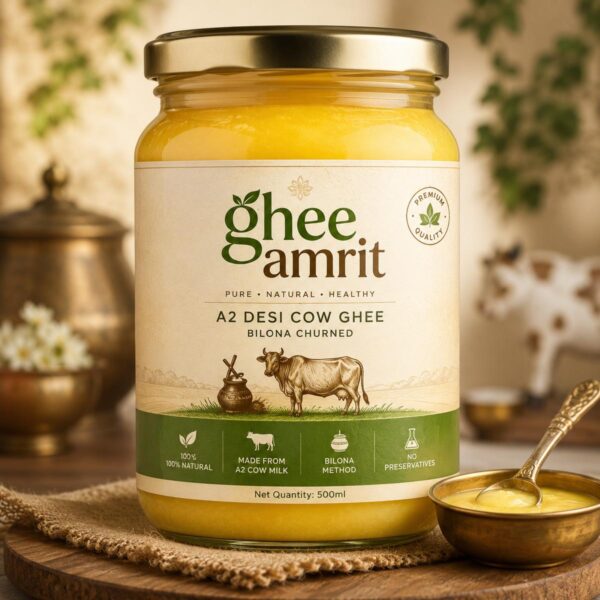
Ghee has been a part of Indian kitchens for generations. From adding it to dal and roti to using it in sweets and traditional recipes, ghee is loved for its rich taste, aroma, and versatility. But when you shop for ghee, you may come across terms such as pure cow ghee, desi ghee, pure ghee, and desi cow ghee.
This often creates confusion. Are pure cow ghee and desi ghee actually different? How are they made? And which one should you choose for your kitchen?
In this article, we will explain the basic differences between pure cow ghee and traditional desi ghee and what you should look for when buying good-quality ghee.
What Is Pure Cow Ghee?
Pure cow ghee is clarified butter made from cow’s milk. The milk or cream is processed and heated until the water evaporates and the milk solids separate from the fat.
The word “pure” generally suggests that the ghee does not contain unwanted additives, artificial colours, or other ingredients. However, the word alone does not tell you how the ghee was prepared.
Some manufacturers use modern cream-based methods, while others follow traditional methods involving curd and butter. Therefore, when buying pure cow ghee, it is useful to check the ingredients and preparation method rather than relying only on the label.
How Is Pure Cow Ghee Made?
In a modern cream-based process, cream is separated from cow’s milk. The cream is then heated under controlled conditions until the water evaporates and the milk solids separate from the fat.
The remaining fat is filtered and packed as ghee.
This method allows manufacturers to produce ghee with a consistent flavour and smooth texture. It is also suitable for large-scale production.
However, traditional ghee can be made through a different process.
What Is Desi Ghee?
Desi ghee is traditionally associated with Indian methods of preparing ghee. One well-known traditional process is the Bilona method.
In this method, milk is first converted into curd. The curd is then churned to separate butter, or makkhan. The butter is slowly heated until it turns into ghee.
This process takes more time and involves additional steps compared with a modern cream-based method. It can also give the finished ghee a distinctive aroma, flavour, and texture.
It is worth remembering that the term “desi ghee” can be used differently by different brands. If traditional preparation matters to you, check how the brand actually makes its ghee.
Pure Cow Ghee vs Desi Ghee: Key Differences
1. Preparation Method
The preparation method is one of the main differences.
Modern pure cow ghee may be made by separating cream from cow’s milk and heating it to produce ghee.
Traditional desi ghee can be made by converting milk into curd, churning the curd to obtain butter, and then slowly heating the butter.
The production method can influence the final flavour, aroma, and texture.
2. Fermentation
Traditional desi ghee made through a curd-based process includes a fermentation stage.
The milk is first converted into curd before it is churned. This is different from directly separating cream from milk.
This additional step contributes to the distinctive taste and aroma often associated with traditionally prepared desi ghee.
3. Taste and Aroma
Taste is another noticeable difference.
Pure cow ghee made through a modern process can have a relatively mild flavour and smooth texture. This makes it suitable for everyday cooking.
Traditional desi ghee generally has a stronger aroma and deeper flavour. It can add a rich taste to Indian dishes and sweets.
If you enjoy the traditional taste of homemade ghee, you may prefer desi ghee.
4. Texture
Texture can also vary depending on the production method and storage conditions.
Traditional desi ghee often develops a natural grainy or slightly granular texture. Many people associate this texture with traditionally prepared ghee.
Modern cream-based ghee may have a smoother and more uniform texture.
However, texture alone cannot prove whether ghee is pure. Temperature, storage, and other factors can also affect the appearance of ghee.
5. Cooking Uses
Both cow ghee and desi ghee can be used for everyday cooking.
Ghee can be used for sautéing, frying, roasting, baking, and adding flavour to cooked food. It is also commonly used in traditional Indian recipes.
Desi ghee is particularly popular in dishes where its aroma and flavour can stand out, such as dal, halwa, paratha, roti, and Indian sweets.
The right choice depends largely on your cooking style and personal preference.
6. Price
You may notice that traditionally prepared ghee can cost more than some commercially produced varieties.
Traditional production can involve more time, additional processing steps, and manual work. The quantity of milk required and the production method can also affect the final price.
However, a higher price does not automatically mean better quality. It is better to consider the ingredients, source of milk, preparation method, and quality standards.
How to Choose Good Quality Ghee
When shopping for pure cow ghee or desi ghee, don’t rely on just one factor.
First, check the ingredient list. A good-quality ghee should have a clear and simple ingredient profile.
Next, look at the preparation method. If you specifically want traditionally prepared ghee, check whether the brand explains its curd-based or Bilona process.
You can also look at the source of the milk and how the ghee is processed and packaged.
Colour, aroma, and texture may provide useful information, but they should not be treated as scientific tests of purity.
Most importantly, choose a brand that is transparent about its ingredients and production process.
Which Is Better: Pure Cow Ghee or Desi Ghee?
There is no single answer for everyone.
If you prefer a mild flavour and smooth texture for regular cooking, a good-quality pure cow ghee can be a practical choice.
If you prefer traditional preparation, a stronger aroma, and the characteristic taste and texture associated with traditionally made ghee, desi ghee may be a better fit for you.
The important thing is not simply whether the label says “pure cow ghee” or “desi ghee.” Look at how the ghee is made, what ingredients are used, and how transparent the brand is about its process.
Final Thoughts
Understanding the difference between pure cow ghee and desi ghee can make choosing ghee much easier.
Both varieties can have a place in an Indian kitchen. Pure cow ghee can be convenient for everyday cooking, while traditionally prepared desi ghee can offer the deeper aroma and flavour that many people love.
At Ghee Amrit, we believe customers should be able to understand what they are buying. Whether you choose pure cow ghee, desi ghee, or another variety, always look at the ingredients and preparation method before making your decision.
Good ghee is not just about the name on the jar. It is about the quality of the ingredients, the care taken during preparation, and choosing a product that suits your kitchen and your preferences.

jaii baba ki
Informative post
My gut has trust issues… especially after street food.
Toh khata kyu ha
love this A2 ghee
Thank you
Ghee can support gut health
buy best ghee
Good Gut Good Butt